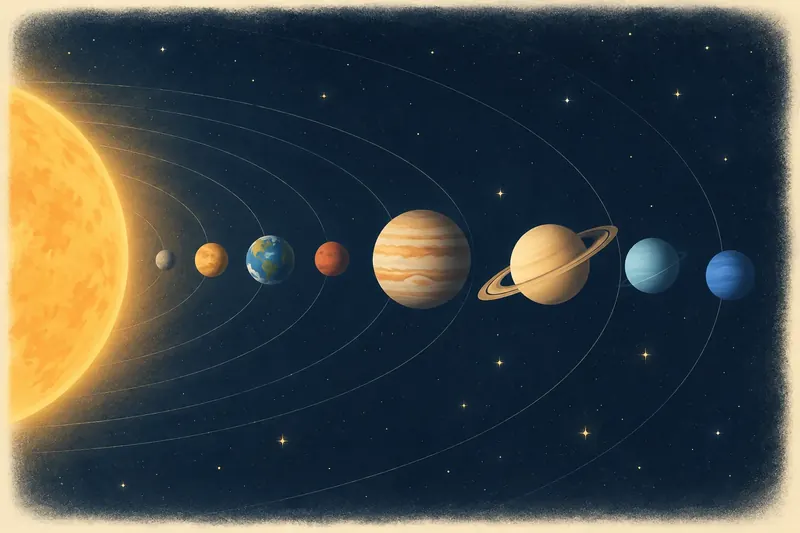
The Solar System
Learning objective
Students describe the planets, moons, and other bodies that orbit the sun, and explain day and night and seasons.
Specific learning objectives
- Name the eight planets in order from the sun.
- Distinguish rotation from revolution.
- Explain why we have day and night.
- Explain why we have seasons.
Big ideas in this unit
- Eight planets orbit the sun in predictable paths.
- Earth rotates once every 24 hours, giving us day and night.
- The tilt of Earth's axis causes the seasons.
The eight named pages below reuse this topic’s ten open-ended questions and teacher response guidance. The collection labels are preserved; they do not indicate eight distinct activities.
All The Solar System printables
8 named review pagesOpen-ended review version; matching activity not included → 02 Fill in the Blank
Open-ended review version; blanks and word bank not included → 03 Short Answer
Open-ended response prompts about this topic → 04 Diagram Labeling
Open-ended review version; labeling diagram not included → 05 Reading Passage
Open-ended review version; reading passage not included → 06 Sort and Classify
Open-ended review version; sorting cards not included → 07 Investigation Lab
Open-ended review version; lab procedure not included → 08 Quick Quiz
Open-ended review version; multiple-choice quiz not included →
How to teach The Solar System
Use the existing prompts to discuss this topic and ask students to explain their reasoning. Select any demonstrations, reading material or experiments separately; these review versions do not supply the distinct activities suggested by their page labels.
Use the existing prompts to discuss this topic and ask students to explain their reasoning. Select any demonstrations, reading material or experiments separately; these review versions do not supply the distinct activities suggested by their page labels.
Use the existing prompts to discuss this topic and ask students to explain their reasoning. Select any demonstrations, reading material or experiments separately; these review versions do not supply the distinct activities suggested by their page labels.
All worksheets A–Z — this topic's 8 labelled pages listed with the other worksheet formats.